
Governments worldwide are cracking down on online gambling, but players aren’t giving up that easily. From total bans to sophisticated self-exclusion systems like GamStop, regulatory approaches vary dramatically—and so do the workarounds.
Take the UK’s GamStop system. Designed to protect problem gamblers, it blocks users from hundreds of licensed casino sites for periods ranging from six months to five years. Noble goal, genuinely. But talk to anyone who’s actually registered, and you’ll hear the same complaint: they signed up during a bad week, changed their mind a month later, and now they’re searching for “casinos not on gamstop” like everyone else.
The reality is messier than policy papers suggest. Some countries ban online gambling entirely and enforce it about as effectively as speed limits on empty highways. Others create heavily regulated markets that inadvertently push players offshore. And a few—like the UK—try to balance protection with access through self-exclusion programs that work brilliantly for some users and frustrate others.
Here’s what’s actually happening with gambling restrictions worldwide, why GamStop has become such a contentious issue, and what players are doing when their government decides they need protection from themselves.
GamStop: Good Intentions, Complicated Outcomes
GamStop represents one of the UK’s most ambitious attempts at player protection. The concept is straightforward: individuals struggling with gambling can register, select a time period (six months, one year, or five years), and immediately block themselves from every UK Gambling Commission-licensed operator.
What happens when someone registers? Every UKGC-licensed operator receives notification and locks that person out. New accounts become impossible to create. Existing accounts get frozen. Marketing communications cease. For the duration selected, that individual cannot legally gamble on any UK-licensed platform.
The program covers over 400 UK gambling sites and costs nothing to use. From a harm reduction perspective, it’s one of the more effective tools available. But there’s a catch: no exceptions, no early exits, no appeals. Changed your mind after two months? Too bad. Feeling confident about your recovery after six months of a year-long ban? The system doesn’t accommodate personal growth timelines.
This inflexibility has created significant demand for non gamstop casino alternatives.
Search “best non gamstop casinos” and you’ll find thousands of results. These are offshore gambling sites—typically licensed in jurisdictions like Malta, Curacao, or Gibraltar—that don’t participate in the UK’s self-exclusion scheme because they’re not required to. They’re not technically illegal for UK players to access, which creates a regulatory gray zone that governments dislike and players actively seek out.
Why the surge in demand for non gamstop sites?
Some individuals registered for GamStop impulsively and genuinely regret it. But that’s not the whole story. Many UK players have grown frustrated with domestic regulations more broadly. The UKGC has implemented increasingly strict measures—deposit limits, reduced slot spin speeds, extensive verification requirements. Some players simply want to gamble without intensive oversight.
Non gamstop casinos offer features UK-licensed sites can no longer provide: larger welcome bonuses (including “free spins no deposit not on gamstop” promotions that domestic operators face restrictions promoting), games not on gamstop that UKGC regulation has effectively removed from the market, cryptocurrency payment options, and generally fewer restrictions on how individuals choose to gamble.
The trade-off? These online casinos not on gamstop operate outside UK jurisdiction. If disputes arise—delayed withdrawals, contested winnings, technical issues—players have significantly less recourse than with UKGC-licensed operators. Some gambling sites not on gamstop maintain legitimate operations with solid reputations. Others are considerably less reputable. Distinguishing between them requires research that many players skip until problems emerge.
Countries Where Online Gambling Is Completely Prohibited
While GamStop allows controlled access, some nations take a fundamentally different approach: total prohibition.
The United Arab Emirates maintains a zero-tolerance policy. Online gambling violates Islamic law, and penalties are substantial enough to deter most would-be players. The government actively blocks international gambling sites, and even accessing them through VPNs carries legal risk—not theoretical risk, but actual potential consequences.
Qatar follows similar principles. Total prohibition based on religious law, active site blocking, and enforcement mechanisms that extend to VPN usage. Despite hosting major sporting events and building world-class infrastructure, legal online gambling remains completely off the table for residents.
North Korea’s approach needs little explanation. Internet access itself is heavily restricted, gambling is prohibited, and most citizens lack the connectivity required to access offshore platforms even if they wanted to. Interestingly, the government apparently operates some casinos for foreign tourists, suggesting economic pragmatism trumps ideological consistency when hard currency is involved.
Brunei enforces a complete gambling ban under Sharia law. No casinos, no betting shops, no lottery, absolutely no online gambling platforms. Citizens looking for casino sites not on gamstop won’t find them because they won’t find any gambling sites at all.
Cambodia presents an interesting contradiction. Land-based casinos are widespread—Sihanoukville essentially transformed into a casino tourism hub. But online gambling for Cambodian citizens? Completely illegal. The government shut down all domestic online gambling operations in 2019, apparently preferring foreign tourists lose money in person rather than locals gambling online.
Singapore takes a more nuanced approach. Online gambling isn’t outright banned, but regulations are so restrictive that only two state-controlled operators have permission to function. All other platforms face blocking measures. It’s prohibition dressed up as tight regulation.
Lebanon’s laws technically prohibit all forms of gambling, though enforcement remains inconsistent. It’s the classic “technically illegal but enforcement varies” situation that many countries find themselves in.
Does prohibition actually eliminate gambling? Obviously not. VPNs exist. Cryptocurrency exists. Offshore gambling sites accept players from anywhere. Individuals in restricted countries who want to gamble find methods—they just do so with increased risk and diminished legal protection.
Countries Attempting Balanced Regulation
Most jurisdictions avoid total prohibition, instead creating regulatory frameworks that attempt to balance access with control. Results vary dramatically.
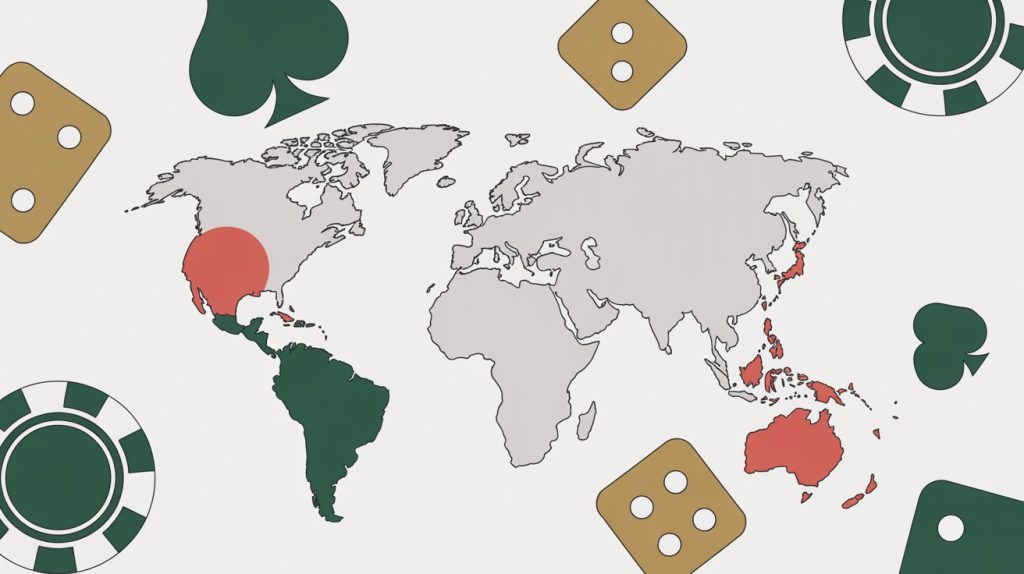
Australia’s approach centers on the Interactive Gambling Act, which prohibits Australian companies from offering online casino games to Australian players. Sports betting and lottery remain permissible, but online pokies and table games are technically illegal. Does this stop Australians from playing? Not remotely. Offshore casinos ignore Australian law, Australian players work around it, and the government struggles to enforce restrictions on foreign servers. Everyone acknowledges the law exists and proceeds regardless.
The United States presents extraordinary complexity. Each state determines its own gambling regulations. New Jersey operates a fully regulated online casino market. Pennsylvania followed suit. Michigan joined recently. Nevada permits sports betting with limited other options. Texas prohibits nearly everything. Then there are states where legal ambiguity reigns because legislation predates the internet.
Federal laws like PASPA and UIGEA add additional layers. Technically they target operators and payment processors rather than players, but try explaining that distinction when your bank blocks a casino deposit. Players in restricted states frequently use offshore betting sites. Whether this constitutes legal gambling depends on which lawyer you consult.
China officially bans all gambling except state-run lotteries. Meanwhile, Macau—technically part of China—generates more gambling revenue than Las Vegas. The contradiction is remarkable. Online gambling faces prohibition on the mainland, yet enforcement remains inconsistent, and numerous Chinese players access offshore platforms regularly.
Germany recently legalized online gambling but implemented regulations so restrictive that many players simply ignored domestic operators. A €1,000 monthly deposit limit applies across all operators. Slots face a €1 maximum bet. Online table games are completely prohibited. The regulations also include an automatic session-ending “panic button” that triggers when losses accumulate rapidly—a feature many players find patronizing.
German players seeking less restrictive experiences turned to non gamstop casinos and other offshore platforms. When legal gambling becomes sufficiently frustrating, players migrate elsewhere.
France maintains a licensed market, but French regulations are notoriously bureaucratic. Most international operators decline to pursue French licensing, so French players use offshore alternatives. The government periodically threatens blocking measures, little changes, and the cycle continues.
Poland permits online gambling only with Polish licensing, which proves nearly impossible to obtain. The government blocks foreign gambling sites through ISPs. Polish players use VPNs. It’s an endless game of regulatory whack-a-mole.
Russia banned online gambling except for sports betting through approved Russian operators. The government actively blocks foreign sites. VPN adoption is widespread. The pattern repeats across jurisdictions.
The Non GamStop Casino Phenomenon
Returning to the UK, where the situation becomes particularly revealing.
Search volume for terms like “casinos not on gamstop uk” and “best non gamstop casinos” has exploded. Every gambling forum hosts discussions about reputable casinos not on gamstop. Affiliate sites maintain entire sections dedicated to non gamstop betting sites. The demand is undeniable.
What distinguishes quality non gamstop casino operators? The same factors that define any reputable casino—legitimate licensing (Malta Gaming Authority or Curacao eGaming represent minimum standards), reliable payment processing, games from established providers, responsive customer service, and transparent terms that don’t disadvantage players.
The appeal is straightforward. Players registered with GamStop can still access these sites. Welcome bonuses tend to be more generous—those “free spins no deposit non gamstop” offers that UK-licensed sites can’t match anymore under current regulations. Payment options expand, including cryptocurrency. Players access slots not on gamstop and games not on gamstop that UKGC regulations have effectively removed from domestic markets. And importantly, players avoid the increasingly intensive oversight that UK-licensed casinos implement.
But gambling sites not on gamstop carry genuine risks. Players operate outside UK consumer protection frameworks. If a no gamstop casino delays withdrawals, the UKGC has no jurisdiction to intervene. Dispute resolution depends entirely on whichever licensing authority governs that casino, and standards vary dramatically. Curacao, for instance, isn’t renowned for aggressive player advocacy.
Some online casino not on gamstop operators are genuinely reputable. They’ve operated for years, hold licenses from respected jurisdictions, process withdrawals reliably, and run verifiably fair games. Others are temporary operations that will accept deposits readily but create obstacles when players attempt withdrawals.
The challenge lies in distinguishing reputable operators from problematic ones before making deposits. Reviews help, though many are affiliate-driven content designed to promote whichever sites offer the highest commissions. Forums provide better insight but remain imperfect. The safest approach involves starting with minimal deposits, testing withdrawal processes with small amounts, and abandoning platforms immediately if anything seems irregular.
What Players Should Know About Non GamStop Casinos
For UK and Australia players specifically considering casino sites not on gamstop, understanding what to look for matters significantly. Licensing jurisdiction, game provider legitimacy, payment method reliability, customer service responsiveness, and terms transparency all require evaluation.

FairCrown Casino: Get up to €10,000 + 500 free spins

Jeetcity Casino: Get up to €10,000 + 180 free spins

Spinrise Casino: Get 111% deposit bonus up to $777 + 111 free spins

Slotlounge Casino: Get up to €15,000 + 350 free spins

Moonwin Casino: Get 100% bonus up to $7,500 + 100 free spins


Goldex Casino: Get up to €38,000 + 500 free spins

WinSpirit Casino: Get 300% up to €400 + 100 free spins
Where Gambling Regulation Heads Next
Gambling regulation is moving in contradictory directions simultaneously, creating tension unlikely to resolve soon.
One trajectory: stricter restrictions, enhanced oversight, heavier regulation. The UK continues adding rules. Germany implemented its controversial €1 stake limit. More countries consider GamStop-style self-exclusion programs. Advertising restrictions spread. Regulatory pressure intensifies.
The opposite trajectory: offshore operators proliferating, crypto casinos gaining popularity, VPN use normalizing, and players becoming increasingly sophisticated about circumventing restrictions.
Governments are learning what the entertainment industry learned with digital piracy: completely stopping determined internet users from accessing desired content is nearly impossible. Authorities can increase difficulty, heighten risk, reduce convenience. Complete prevention? Unlikely.
Cryptocurrency gambling particularly complicates traditional regulatory approaches. How do authorities enforce GamStop on decentralized casinos that don’t collect personal information and accept only Bitcoin? How do they block sites without fixed domains? How do they regulate operators existing in no specific jurisdiction?
They probably can’t. Which suggests the future involves what we’re already seeing—legitimate regulated markets for players wanting protection and oversight, offshore markets for players prioritizing freedom and privacy, and numerous players moving between both depending on circumstances.
Practical Considerations for Players
Players in countries with gambling restrictions face choices. None are perfect.
For GamStop-registered individuals considering non gamstop casinos: prioritize safety. Focus on sites with Malta or Gibraltar licensing when possible. Start with small deposits. Test withdrawal processes before committing larger amounts. Read authentic player reviews, not affiliate marketing content. And consider honestly whether circumventing a voluntary self-exclusion represents wise decision-making.
For residents of countries with complete bans: using offshore sites and VPNs carries legal risk that varies dramatically by jurisdiction. Some places technically prohibit it but never enforce. Others prohibit it and enforce occasionally enough to create genuine concern. Only individual players can evaluate whether that risk seems worthwhile, but awareness matters.
For players in partially regulated markets like the US or Australia: explore our Pokies Critic Online Casinos, understand local laws, recognize trade-offs between regulated and offshore operators, and don’t assume widespread participation means zero risk.
The gambling industry isn’t disappearing. Governments won’t stop attempting control. Players won’t stop finding alternatives. This cycle likely continues indefinitely. Only specific tactics evolve.
Whether GamStop genuinely helps or merely provides security theater depends entirely on perspective. Same with broader gambling restrictions. Some individuals need external controls for protection. Others can gamble responsibly without government oversight. The problem: one-size-fits-all regulation serves neither group particularly well.
What’s your assessment? Do tools like GamStop actually protect people, or do they inadvertently drive players toward less safe alternatives? Share your perspective in the comments—especially if you’ve used non gamstop sites and have opinions about which operators are trustworthy versus which should be avoided.